


The real estate industry has undergone a fundamental digital transformation. Property discovery, agent engagement, transactions, and even post-sale services are now largely driven by mobile and web applications. With more than 90% of home buyers starting their property search online (National Association of Realtors), mobile-first real estate platforms have become a business necessity rather than a competitive advantage. However, developing a modern real estate app is far more complex than building a basic mobile application. Today’s platforms function as full-scale digital ecosystems, integrating Multiple Listing Services (MLS), AI-powered recommendations, immersive virtual tours, secure transactions, and enterprise-grade analytics. As these capabilities expand, so do the variables that influence development effort and cost. As a result, one question consistently arises among enterprises and PropTech leaders: What is the real estate app development cost, and what factors truly drive it?
This guide provides a transparent, feature-level breakdown of real estate app development cost, helping enterprises, brokers, and PropTech founders understand how budgets are allocated across features, integrations, UI customization, and scalability requirements. More importantly, it offers practical insights into optimizing ROI without compromising performance, security, or long-term growth.
Why Real Estate App Development Costs Vary Widely
Unlike basic consumer apps, modern real estate platforms integrate a wide range of advanced capabilities, including MLS connectivity, AI-powered recommendations, immersive virtual tours, secure transactions, and enterprise-grade analytics. These capabilities significantly enhance user experience and operational efficiency, but they also introduce complexity, making real estate app development cost a critical and often challenging question for enterprises and PropTech leaders.
There is no fixed or universal pricing model for PropTech solutions. Real estate app development cost can range from $30,000 for a basic MVP to $300,000+ for an enterprise-grade real estate platform, depending on scope, features, and long-term scalability requirements. This wide cost range exists because real estate applications are built for vastly different use cases – consumer-facing property marketplaces, internal broker platforms, investor dashboards, and white-labeled solutions for large franchises.
A basic real estate mobile app with property listings, search, and filters has significantly lower development complexity than an advanced platform offering AI-powered recommendations, virtual property tours, MLS integrations, CRM connectivity, secure payments, and compliance-ready data handling. As functionality expands, so do development timelines, infrastructure needs, security requirements, and ongoing maintenance costs.
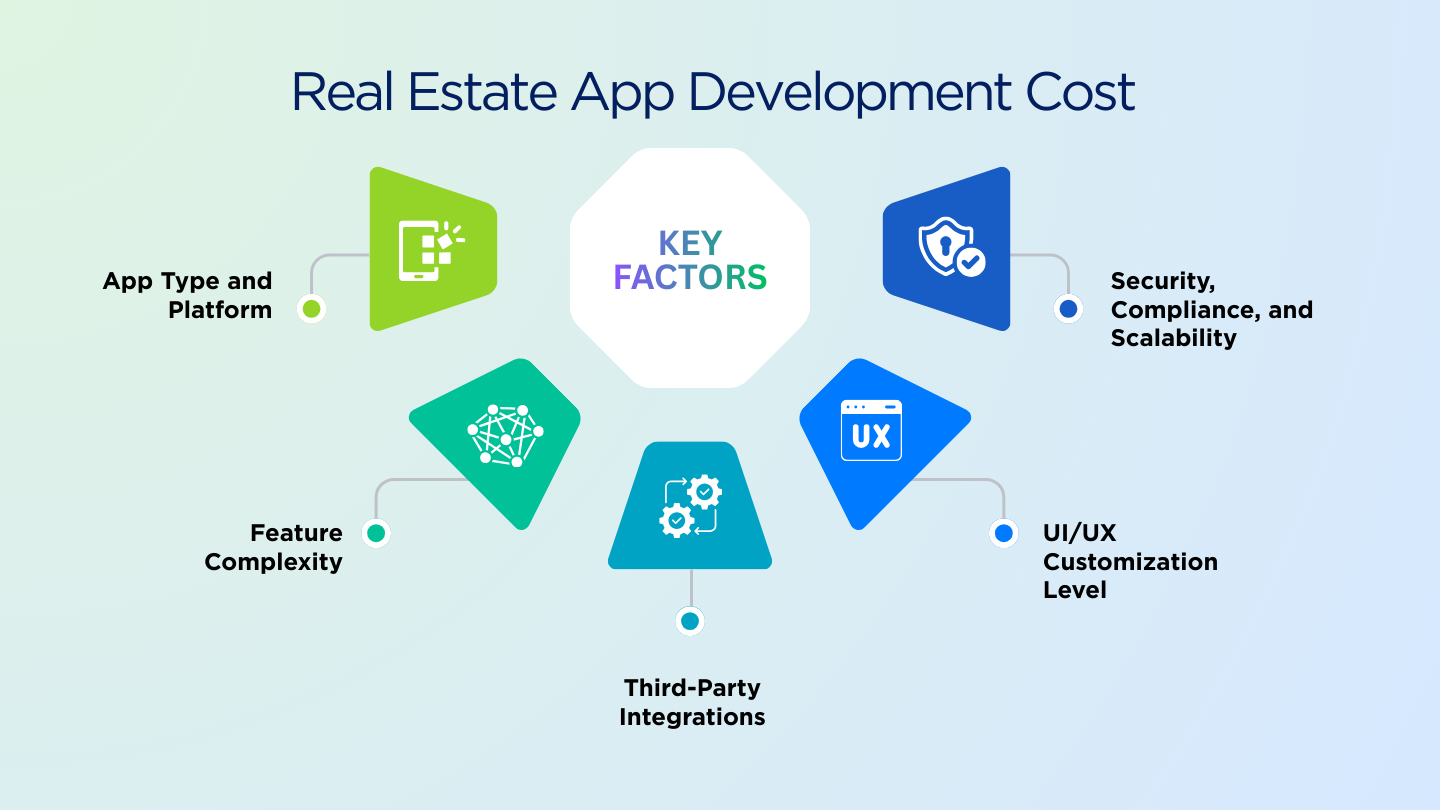
Several core factors influence the cost to build a real estate app, including:
- MVP vs Enterprise Real Estate Platforms
- MVP real estate apps are typically designed for startups or early market validation. They focus on essential features such as listings, basic search, and user authentication, keeping initial real estate app development costs relatively low.
- Enterprise real estate platforms support high user volumes, complex workflows, advanced analytics, role-based access control, and regulatory compliance, resulting in significantly higher development and operational investment.
- Custom Development vs Template-Based Solutions
- Template-based real estate apps reduce upfront PropTech app development costs and accelerate time-to-market, but offer limited flexibility, scalability, and brand differentiation.
- Custom real estate app development enables tailored user experiences, proprietary workflows, and deep third-party integrations, increasing initial cost but delivering stronger long-term ROI and competitive advantage.
Ultimately, real estate app development cost is not driven by the app category alone, but by business objectives, feature depth, UI/UX customization, integration complexity, and scalability expectations. Defining these parameters early allows enterprises and PropTech leaders to build accurate budgets, avoid cost overruns, and maximize return on investment.
Enterprise vs Startup Cost Expectations
Understanding the difference between enterprise and startup cost expectations is critical when estimating real estate app development investments. While both may pursue similar digital capabilities, their priorities – and therefore their cost structures – are fundamentally different. Startups typically optimize for speed-to-market and early validation, whereas enterprises prioritize scalability, security, compliance, and long-term maintainability from day one. These enterprise-grade requirements materially increase development complexity and overall cost but are essential for sustained ROI.
For enterprises, costs extend well beyond feature development. They must account for future growth, system resilience, and integration with existing digital ecosystems. In contrast, startups often accept technical trade-offs to reduce initial spend, with the intent to refactor later – an approach that is rarely viable at enterprise scale.
Enterprise requirements that significantly influence development cost include:
- Advanced system architecture
Modular, cloud-native, and API-first architectures are required to support high user volumes, regional expansion, and evolving business models. - Higher security and compliance standards
Enterprises must meet stringent regulatory and data protection requirements (e.g., SOC 2, GDPR), driving additional investment in security design, audits, and governance. - Robust backend infrastructure
High availability, disaster recovery, performance optimization, and monitoring are essential to ensure reliability for mission-critical operations. - Integration with existing enterprise systems
Seamless connectivity with CRMs, ERPs, data warehouses, analytics platforms, and identity systems adds both development and ongoing maintenance costs.
Industry data reinforces the importance of upfront planning. According to Gartner, more than 70% of enterprise digital products exceed initial cost estimates when scalability and integration requirements are underestimated, highlighting the financial risk of treating enterprise platforms like startup MVPs. McKinsey research similarly shows that well-architected digital platforms can drive significant operational efficiency gains, validating higher upfront investment when aligned with long-term business objectives.
In practice, enterprises that prioritize long-term ROI over short-term cost savings are better positioned to scale their real estate platforms efficiently – avoiding costly rebuilds, security gaps, and performance bottlenecks as adoption grows.
Key Factors That Influence Real Estate App Development Cost
App Type and Platform
App type and platform selection are one of the most significant drivers of real estate app development cost. The choice directly affects development effort, testing scope, performance optimization, deployment workflows, and long-term maintenance. Enterprises must evaluate platform strategy not only from a cost perspective, but also in terms of scalability, user experience, and future growth.
Native development for iOS or Android delivers the best performance, deeper OS-level integrations, and a highly optimized user experience. However, this approach requires separate codebases, dedicated testing cycles, and higher engineering effort, resulting in increased development cost.
Cross-platform frameworks such as Flutter or React Native offer a more cost-efficient alternative by enabling a single codebase across platforms. While this reduces development time and initial investment, there may be trade-offs in performance or advanced native feature support, particularly for complex real estate functionalities like AR/VR tours or high-frequency data updates.
Many enterprise-grade real estate platforms go beyond mobile-only experiences and require a web + mobile ecosystem. This approach supports internal dashboards, agent portals, analytics interfaces, and administrative controls, significantly increasing scope but delivering superior scalability and operational flexibility.
Typical cost implications by platform strategy include:
- iOS or Android (Native)
Higher cost, best performance, ideal for premium consumer and enterprise experiences - Cross-platform (Flutter, React Native)
Moderate cost, faster time-to-market, suitable for MVPs and mid-scale platforms - Web + Mobile Ecosystem
Highest cost, enterprise scalability, essential for multi-role and multi-region deployments
For enterprises, platform decisions should be aligned with long-term business objectives rather than short-term savings. A well-planned platform strategy helps control real estate app development cost over time by minimizing rework, ensuring consistent user experience, and supporting future expansion without architectural limitations.
Feature Complexity
Feature complexity is the single largest driver of real estate app development cost. While basic features enable property discovery, advanced capabilities are what drive user engagement, conversions, and long-term operational efficiency for enterprises and PropTech platforms. As feature depth increases, so do requirements around backend architecture, data processing, third-party integrations, and ongoing maintenance.
At a foundational level, real estate apps focus on enabling users to browse and shortlist properties. These features are relatively straightforward to implement and are common in MVPs or early-stage platforms. However, enterprise-grade applications quickly move beyond discovery to support personalization, communication, automation, and analytics, each adding layers of technical complexity and cost.
Feature sets typically fall into the following tiers:
Basic Features (Lower Cost Impact)
These support core functionality and faster time-to-market:
- User registration and profile management
- Property listings and basic search
- Filters by price, location, and property type
- Favorites and shortlisting
Advanced Features (Moderate to High Cost Impact)
These enhance engagement and improve conversion rates:
- AI-powered property recommendations
- In-app messaging and push notifications
- Saved searches and alerts
- Agent dashboards and lead management
Enterprise and Intelligent Features (Highest Cost Impact)
These significantly increase development scope but deliver strong ROI:
- AI-driven personalization and predictive search
- CRM, ERP, and MLS integrations
- Advanced analytics and reporting
- Compliance-ready data handling and audit logs
As feature complexity increases, development teams must account for performance optimization, scalability, security, and future extensibility. For enterprises, investing in the right feature set upfront helps control long-term real estate app development cost by reducing technical debt and avoiding costly rebuilds as the platform scales.
Third-Party Integrations
Third-party integrations play a critical role in determining real estate app development cost, as modern real estate platforms rarely function as standalone systems. To deliver real-time data, seamless transactions, and enterprise-grade workflows, apps must connect with multiple external platforms, each adding to both initial development effort and long-term operational complexity.
Integrations typically require custom APIs, data synchronization logic, security validation, and ongoing monitoring to ensure reliability as external systems evolve. Beyond one-time development, many integrations also introduce recurring costs related to licensing, usage limits, version upgrades, and support.
Common third-party integrations in real estate apps include:
- MLS integrations for real-time property listings, pricing updates, and regional coverage
- CRM systems to manage leads, customer interactions, and sales pipelines
- Payment gateways for booking fees, deposits, and transaction processing
- Analytics and marketing tools to track user behavior and campaign performance
- Mapping and geolocation services for location-based search and neighborhood insights
While these integrations increase upfront costs, they often deliver significant long-term value by reducing manual workflows, improving data accuracy, and enabling automation across sales and operations. For enterprise platforms, careful planning around third-party integrations is essential to balance real estate app development cost with scalability, reliability, and ROI.
UI/UX Customization Level
UI/UX design is a major contributor to real estate app development cost, directly influencing user engagement, retention, and conversion rates. While a templated or off-the-shelf interface can reduce upfront expenses and accelerate development timelines, it often limits differentiation and long-term scalability, especially for enterprise and brand-driven PropTech platforms.
Custom UI/UX design, on the other hand, is tailored to your brand identity, user personas, and business goals. It requires additional effort in user research, wireframing, interaction design, usability testing, and visual design, which increases initial cost but delivers significantly higher returns over time. According to research by the Nielsen Norman Group, intuitive and user-centered UX design improves usability, strengthens brand trust, and increases user loyalty – key drivers of ROI in competitive real estate markets.
Key considerations that impact UI/UX cost include:
- Templated vs custom design (speed and cost efficiency vs differentiation and scalability)
- User journey complexity across buyers, sellers, agents, and administrators
- Brand-specific visual identity and consistency across platforms
- Accessibility and usability standards for diverse user groups
- Design optimization for conversion, such as lead capture and property inquiries
For enterprises and high-growth PropTech companies, investing in custom UI/UX is often a strategic decision – one that increases engagement, supports higher conversion rates, and ultimately justifies the added development cost through stronger long-term performance.
Security, Compliance, and Scalability
Security, compliance, and scalability are non-negotiable cost drivers in enterprise real estate app development. These platforms routinely handle sensitive personal data, financial transactions, property documents, and contractual information, making robust security and regulatory adherence essential from day one.
Enterprise-grade real estate apps require advanced backend architecture, data encryption (at rest and in transit), secure authentication mechanisms, and continuous monitoring to protect against evolving cybersecurity threats. Compliance with regulations and standards such as GDPR, SOC 2, and regional data protection laws adds further complexity, often increasing development and operational costs. However, these investments significantly reduce legal, financial, and reputational risks.
Scalability is equally critical. As user volumes grow and feature sets expand, the application must maintain performance and reliability without disruption. This typically involves cloud-native infrastructure, load balancing, and resilient system design, all of which influence overall cost but are essential for long-term sustainability.
Key factors that impact cost in this area include:
- Data security measures, including encryption, access controls, and secure APIs
- Regulatory compliance requirements (GDPR, SOC 2, industry-specific standards)
- Authentication and authorization frameworks for multi-role users
- Scalable backend architecture to support growing users and listings
- Ongoing monitoring and threat detection to mitigate cybersecurity risks
While these requirements increase upfront development investment, they are critical for enterprise readiness – ensuring trust, compliance, and the ability to scale confidently in competitive PropTech markets.
| Cost Factor | Description | Cost Impact |
|---|---|---|
| App Type & Platform | Native, cross-platform, or full web + mobile ecosystem selection. | Medium–High |
| Feature Complexity | From basic listings to AI, virtual tours, messaging, and automation. | High |
| Third-Party Integrations | MLS, CRM, payment, analytics, and marketing system integrations. | Medium–High |
| UI/UX Customization | Templated UI vs custom, brand-led UX design. | Medium |
| Security & Compliance | Encryption, access controls, GDPR/SOC 2 readiness. | High |
| Scalability Needs | Cloud-native architecture and performance optimization. | Medium–High |
| Backend Architecture | Real-time data handling and enterprise system support. | Medium |
| Maintenance & Support | Updates, monitoring, and long-term enhancements. | Ongoing |
Real Estate App Development Cost Breakdown by Features
Core Features (Baseline Cost)
Core features form the foundation of any real estate mobile application and represent the baseline real estate app development cost. These capabilities enable users to discover properties, create profiles, and interact with listings, making them essential regardless of whether the app is built for startups or enterprise use cases.
At this stage, development focuses on stability, usability, and clean data flows rather than advanced intelligence or automation. Costs can vary based on UI depth, platform choice (iOS, Android, or cross-platform), and the level of customization required.
Typical core features include:
- User registration and role-based profiles (buyers, sellers, agents)
- Property listings with images and descriptions
- Search functionality with basic filters (price, location, property type)
- Map-based property views using geolocation services
Estimated cost range: $25,000 – $40,000
Advanced Features (Mid to High Cost)
Advanced features significantly elevate a real estate app from a basic listing platform to a high-engagement, conversion-focused digital product. These capabilities enhance user experience, streamline agent workflows, and introduce intelligent automation, making them a major driver of real estate app development cost at the mid to high tier.
At this stage, development moves beyond static functionality into AI-driven personalization and real-time interaction, which require more sophisticated backend logic, data processing, and integration efforts. As a result, these features contribute meaningfully to both budget and long-term ROI.
Common advanced features include:
- AI-powered property recommendations based on user behavior and preferences
- In-app chat and messaging, including agent communication and chatbots
- Appointment scheduling with agent availability and calendar sync
- Push notifications for new listings, price changes, and updates
- Saved searches and alerts to drive repeat engagement
According to McKinsey, AI-driven personalization can increase digital engagement by 20–30%, while studies from HubSpot indicate that intelligent automation improves lead response and qualification efficiency. These gains directly impact conversion rates and customer satisfaction, making advanced features a strategic investment rather than a cost add-on.
Estimated cost range: $40,000 – $80,000
Premium Emerging Features (High Cost)
Premium and emerging features represent the highest tier of real estate app development cost, typically adopted by enterprise platforms and market leaders seeking strong differentiation and long-term competitive advantage. These capabilities leverage advanced visualization, AI, and analytics to deliver immersive, intelligent experiences that go well beyond traditional property discovery.
Implementing these features requires specialized skills, advanced infrastructure, and deeper integration with AI/ML frameworks and 3D technologies, driving higher development effort and cost. However, the return on investment is often substantial. According to RISMedia, property listings with virtual tours receive up to 300% more engagement than static listings, while research from Boston Consulting Group highlights that immersive and AI-driven experiences are increasingly becoming a competitive necessity in modern real estate.
Premium and emerging features commonly include:
- 3D virtual property tours for immersive, remote exploration
- AR/VR property visualization for virtual staging and spatial understanding
- Predictive analytics for pricing trends and buyer behavior insights
- Generative AI assistants for conversational search, support, and recommendations
These features not only improve engagement and lead quality but also position real estate brands as technology leaders within the PropTech ecosystem.
Estimated cost range: $80,000 – $150,000+
| Feature Tier | Description | Key Features Included | Estimated Cost Range |
|---|---|---|---|
| Core Features (Baseline) | Foundational functionality focused on stability, usability, and property discovery. Suitable for MVPs and early-stage platforms. |
|
$25,000 – $40,000 |
| Advanced Features (Mid–High) | Enhances engagement, conversion, and operational efficiency using AI and real-time interactions. Common in growth-stage and enterprise apps. |
|
$40,000 – $80,000 |
| Premium & Emerging Features (High) | Differentiation-focused capabilities using immersive tech and advanced AI. Typically adopted by enterprise and market-leading platforms. |
|
$80,000 – $150,000+ |
Cost of Real Estate App Integrations
Third-party integrations are a major component of real estate app development cost, particularly for enterprise-grade and PropTech platforms. Modern real estate applications must operate as connected ecosystems – pulling data from external systems, automating workflows, and ensuring real-time accuracy across listings, transactions, and customer interactions. Each integration introduces technical complexity, security considerations, and ongoing maintenance requirements that directly influence overall cost.
Below is a comprehensive breakdown of the most common real estate app integrations and their cost implications.
MLS Integration Cost
MLS integration is often the most complex and cost-intensive integration in real estate app development. It enables real-time access to property listings, pricing, availability, and regional data, making it critical for user trust and platform credibility.
Cost varies based on several factors:
- Regional vs national MLS systems, each with different APIs and data standards
- Real-time synchronization requirements to keep listings accurate and up to date
- Data normalization and mapping across multiple MLS sources
According to the National Association of Realtors, accurate MLS data is essential for maintaining buyer trust and engagement, making this integration a non-negotiable investment for serious real estate platforms.
Estimated cost: $15,000 – $40,000
CRM & ERP Integration
CRM and ERP integrations connect the real estate app with internal sales, marketing, and operations systems – enabling centralized customer data, lead tracking, and automated workflows. Popular platforms include Salesforce, HubSpot, and custom enterprise CRMs.
Key cost drivers include:
- Depth of CRM customization and automation logic
- Bi-directional data sync between app and backend systems
- Integration with ERP tools for finance, reporting, or operations
Salesforce reports that effective CRM implementation significantly improves customer relationships and lead conversion, making this integration especially valuable for brokers, enterprises, and large real estate firms.
Estimated cost: $10,000 – $30,000
Payments, Transactions & E-Signatures
As real estate transactions move increasingly online, secure financial and documentation workflows have become essential. These integrations support booking fees, deposits, contract signing, and escrow-related processes within the app.
Typical integrations include:
- Payment gateways (Stripe, Razorpay, PayPal)
- E-signature platforms for contracts and agreements
- Transaction and escrow systems
Statista highlights the rapid growth of digital payments in real estate, reinforcing the need for secure, compliant transaction flows, particularly for enterprise and marketplace-style apps.
Estimated cost: $8,000 – $20,000
Analytics & Marketing Tools
Analytics and marketing integrations provide visibility into user behavior, campaign performance, and funnel drop-offs, helping teams continuously optimize the app experience and marketing ROI.
Common tools include:
- Google Analytics or GA4
- Marketing automation platforms
- Attribution and performance tracking tools
Business News Daily notes that data-driven decision-making significantly improves marketing effectiveness, making analytics a critical long-term investment rather than an optional add-on.
Estimated cost: $5,000 – $15,000
While integrations increase upfront real estate app development cost, they are often essential for scalability, automation, and operational efficiency. For enterprise platforms, well-planned integrations reduce manual work, improve data accuracy, and deliver measurable ROI over time.
| Integration Type | Purpose & Business Value | Key Cost Drivers | Estimated Cost Range |
|---|---|---|---|
| MLS Integration | Enables real-time access to property listings, pricing, availability, and regional data – critical for platform credibility and user trust. |
|
$15,000 – $40,000 |
| CRM & ERP Integration | Centralizes customer data, automates lead management, and connects sales, marketing, and operations workflows across systems. |
|
$10,000 – $30,000 |
| Payments, Transactions & E-Signatures | Supports secure online transactions, contract signing, deposits, and escrow-related workflows within the app. |
|
$8,000 – $20,000 |
| Analytics & Marketing Tools | Provides insight into user behavior, campaign performance, and conversion funnels to optimize growth and ROI. |
|
$5,000 – $15,000 |
UI/UX Design & Customization Cost
UI/UX design plays a critical role in determining both the usability and commercial success of a real estate application. Beyond aesthetics, effective UI/UX design directly impacts user engagement, lead conversion, and customer retention, making it a core contributor to overall real estate app development cost.
The cost of UI/UX design varies significantly based on the level of customization, branding requirements, and depth of user experience research involved. For real estate platforms operating in competitive markets, investing in strong UI/UX is often a strategic decision rather than a discretionary expense.
Standard UI vs Custom UI Design
The choice between a standard, template-based interface and a fully custom UI/UX design has a direct impact on both development timelines and cost.
Template-based UI solutions typically rely on pre-built components and standardized layouts, allowing for faster development and lower upfront costs. These designs are suitable for MVPs or early-stage real estate apps where speed-to-market is a priority and differentiation is less critical.
Custom UI/UX design, on the other hand, involves designing interfaces from the ground up based on user personas, behavioral data, and conversion goals. This approach enables optimized user flows for property discovery, agent interactions, and lead capture, resulting in higher engagement and stronger brand positioning.
Forbes highlights that well-designed, intuitive interfaces significantly improve user engagement and trust, particularly in high-consideration industries like real estate.
Estimated cost range:
- Template-based UI: $10,000 – $20,000
- Fully custom UI/UX design: $30,000 – $100,000
Branding & Personalization
Branding and personalization elevate a real estate app from a functional tool to a differentiated digital experience. This layer of UI/UX customization ensures that the application reflects the company’s identity while supporting multiple user roles and workflows.
Common branding and personalization elements include white-labeling, custom design systems, role-based dashboards for buyers, sellers, and agents, and personalized user journeys based on behavior and preferences. These features are especially important for brokerages, enterprises, and marketplace platforms that want to maintain brand consistency across digital touchpoints.
In competitive real estate markets, a strong branded experience builds trust, improves recall, and reinforces credibility – factors that directly influence lead quality and conversion rates.
- Additional cost impact: $15,000 – $30,000
UX Impact on Conversion & Long-Term Cost Efficiency
While UI/UX design increases upfront development cost, it often reduces long-term acquisition and operational expenses by improving conversion efficiency and user retention. Well-optimized UX minimizes friction in critical flows such as search, inquiry submission, appointment booking, and onboarding.
According to Forrester, strong UX design can improve conversion rates by up to 200%, while studies from UX Matters demonstrate a clear correlation between positive user experience and increased sales performance in digital products. In real estate app development, these gains translate into higher lead conversion, reduced churn, and better ROI over time.
Investing in UX research, usability testing, and iterative design helps balance development costs against measurable revenue impact, making UI/UX one of the highest-leverage investments in a real estate app.
Estimated UI/UX Design & Customization Cost
Overall UI/UX cost range: $10,000 – $35,000+
Final costs depend on:
- Level of customization and branding
- Number of user roles and dashboards
- Depth of UX research and testing
- Platform scope (mobile, web, or cross-platform)
A well-executed UI/UX strategy not only enhances the user experience but also directly influences the success, scalability, and profitability of a real estate application.
Cost Comparison – MVP vs Enterprise Real Estate App
Comparison Table
| Aspect | MVP Real Estate App | Enterprise Real Estate App |
|---|---|---|
| Target Users | Startups, early-stage PropTech companies, pilot projects | Large brokerages, enterprises, property managers, real estate marketplaces |
| Feature Scope | Core functionality only (user registration, property listings, search, basic filters) | Advanced features including AI-driven recommendations, automation, analytics, and operational tools |
| AI & Automation | Not included or very limited | AI-powered personalization, predictive analytics, chatbots, and generative AI assistants |
| Integrations | Minimal integrations (basic maps, limited APIs) | Extensive integrations with MLS, CRM, ERP, payment gateways, analytics, and marketing platforms |
| UI/UX Design | Template-based or lightly customized UI | Fully custom, branded UI/UX with role-based dashboards and conversion-optimized flows |
| Security & Compliance | Basic authentication and data protection | Enterprise-grade security, encryption, role-based access, GDPR/SOC 2 compliance |
| Scalability & Performance | Limited scalability; suitable for small user bases | High scalability with cloud-native architecture and load handling for large volumes |
| Backend Architecture | Simple monolithic or lightweight backend | Modular or microservices-based architecture with high availability |
| Maintenance & Support | Minimal post-launch support | Ongoing maintenance, monitoring, performance optimization, and feature expansion |
| Time to Market | Faster (8–12 weeks) | Longer due to complexity (4–9 months) |
| Estimated Development Cost | $30,000 – $60,000 | $150,000 – $300,000+ |
Ongoing Costs Beyond Initial Development
Beyond the initial build, real estate app development involves ongoing operational costs that are critical to maintaining performance, security, and scalability over time. These recurring investments directly impact the total cost of ownership and should be factored into long-term budgeting, especially for enterprise and growth-focused PropTech platforms.
Maintenance & Updates
Post-launch, real estate apps require continuous maintenance to remain stable and secure. This includes bug fixes, operating system upgrades, performance optimizations, and regular security patches as platforms, devices, and third-party services evolve.
In practice, annual maintenance typically accounts for 15–25% of the initial development cost, or approximately $5,000 to $15,000 per year for mid-sized applications. Industry analysis from ITProPortal emphasizes that consistent maintenance is essential for application resilience, uptime, and long-term usability, particularly for apps handling transactions and sensitive customer data.
Cloud Infrastructure & Hosting
Modern real estate applications rely on scalable cloud infrastructure to support real-time listings, high-resolution media, analytics, and fluctuating user traffic. Hosting platforms such as AWS, Azure, or Google Cloud Platform (GCP) are commonly used for their reliability and elasticity.
Monthly cloud infrastructure costs typically range from $500 to $5,000+, depending on traffic volume, data storage requirements, and performance needs. A report from CIO highlights that proactive cloud cost optimization is critical to maintaining performance without unnecessary overspend as usage scales.
Feature Enhancements & Scaling
As user demand grows and market expectations evolve, ongoing investment in feature enhancements becomes necessary. This often includes AI upgrades, new third-party integrations, advanced analytics, and performance scaling.
Over time, these enhancements can add $20,000 to $50,000 or more, depending on scope and complexity. According to a PwC white paper on the future of PropTech, continuous innovation and functional expansion are essential for maintaining competitiveness and meeting changing customer expectations – making feature scaling a strategic, long-term investment rather than an optional cost.
How to Optimize Real Estate App Development Cost
Optimizing real estate app development cost requires a balance between speed, functionality, and long-term scalability. The most successful PropTech platforms approach cost optimization strategically, focusing investment where it delivers measurable business value while avoiding unnecessary complexity early on.
- Prioritize High-Impact Features
Focus development efforts on features that directly improve user experience and conversion, such as intuitive search, listings, and core engagement workflows. Building what users actively need – rather than overloading the product – reduces development waste and improves ROI. - Start with an MVP and Iterate
Adopting an MVP-first approach enables faster market entry and controlled initial costs. By launching with essential features and iterating based on real user feedback, teams can make data-driven investment decisions instead of assumptions. - Plan Integrations Early
Third-party integrations such as MLS, CRM, and payments should be planned during the architecture phase, not added later. Early integration planning avoids rework, minimizes technical debt, and leads to more predictable development costs. - Prioritize Scalable Architecture
Designing for scalability from the outset ensures the platform can grow without major refactoring. While this may slightly increase upfront cost, it significantly reduces long-term expenses associated with performance bottlenecks and system rewrites. - Choose a Domain-Experienced Development Partner
Working with a development partner experienced in real estate or PropTech reduces risk, shortens development cycles, and improves cost efficiency. Domain expertise enables stronger architectural decisions, faster handling of MLS and third-party integrations, and alignment with industry-specific compliance and scalability requirements.Teams like Wow Labz, with deep experience in building enterprise-grade PropTech and data-driven platforms, help organizations avoid common cost overruns while accelerating time-to-market through proven frameworks and real estate-focused engineering expertise.
Conclusion: Budgeting for Long-Term ROI, Not Just Initial Cost
Real estate app development cost is not a fixed number; it is the outcome of strategic choices made across features, platforms, integrations, design, and long-term scalability. As this guide has outlined, costs can range from lean MVP builds to complex enterprise platforms, depending on business goals, user expectations, and operational requirements.
For startups, speed-to-market and validation often take priority. For enterprises, however, scalability, security, compliance, and integration-readiness must be engineered from day one. Underestimating these factors frequently leads to cost overruns, rework, and delayed ROI. The most successful PropTech platforms are those that balance short-term cost control with long-term architectural foresight, ensuring that today’s investments continue to deliver value as the platform scales.
Ultimately, optimizing real estate app development cost is less about cutting features and more about prioritizing the right capabilities at the right stage, choosing scalable architectures, and planning integrations early. A structured approach – grounded in domain expertise – enables organizations to build robust digital products without unnecessary complexity or waste.
How Wow Labz Helps Optimize Real Estate App Development Cost
At Wow Labz, we help enterprises and PropTech companies design and build real estate applications that are scalable, secure, and cost-efficient by design. Our approach goes beyond development – we focus on engineering for long-term ROI.
Our expertise spans:
- End-to-end real estate app development, from MVPs to enterprise-grade platforms
- Cost-optimized architecture design, ensuring scalability without overengineering
- Complex integrations, including MLS, CRM/ERP, payments, analytics, and AI systems
- Advanced UI/UX customization, balancing brand differentiation with development efficiency
- AI-driven features and data platforms, enabling personalization, predictive insights, and automation
By combining deep PropTech domain knowledge with strong engineering discipline, Wow Labz helps organizations avoid common cost pitfalls, accelerate time-to-market, and build platforms that scale confidently as business needs evolve. Learn more about our real estate and PropTech development expertise
If you’re evaluating real estate app development costs or planning your next PropTech initiative, Wow Labz can help you make the right trade-offs between cost, capability, and growth.

FAQs – Real Estate App Development Cost
How much does it cost to build a real estate app?
The cost can range from $25,000 for basic functions to over $300,000 for highly complex apps with advanced features. A study conducted by Statista underscores the correlation between complexity and pricing, showcasing the investment required for high-quality app solutions.
What features increase cost the most?
Factors like AI capabilities, integrations with MLS, and custom UI/UX design tend to inflate costs the most. As indicated by a manual produced by Shopify, rightly prioritizing feature sets is essential for app success.
Is MLS integration expensive?
Yes, MLS integration costs typically fall between $10,000 and $40,000, depending on the scope and regional complexity. Real-world case study examples from Inman illustrate the importance of designing effective MLS integration strategies.
How long does development take?
Development timelines can vary significantly; MVPs can take 3-6 months while enterprise apps might require 6-12 months. According to project management insights by PMI, comprehensive planning is crucial for timely app launches.