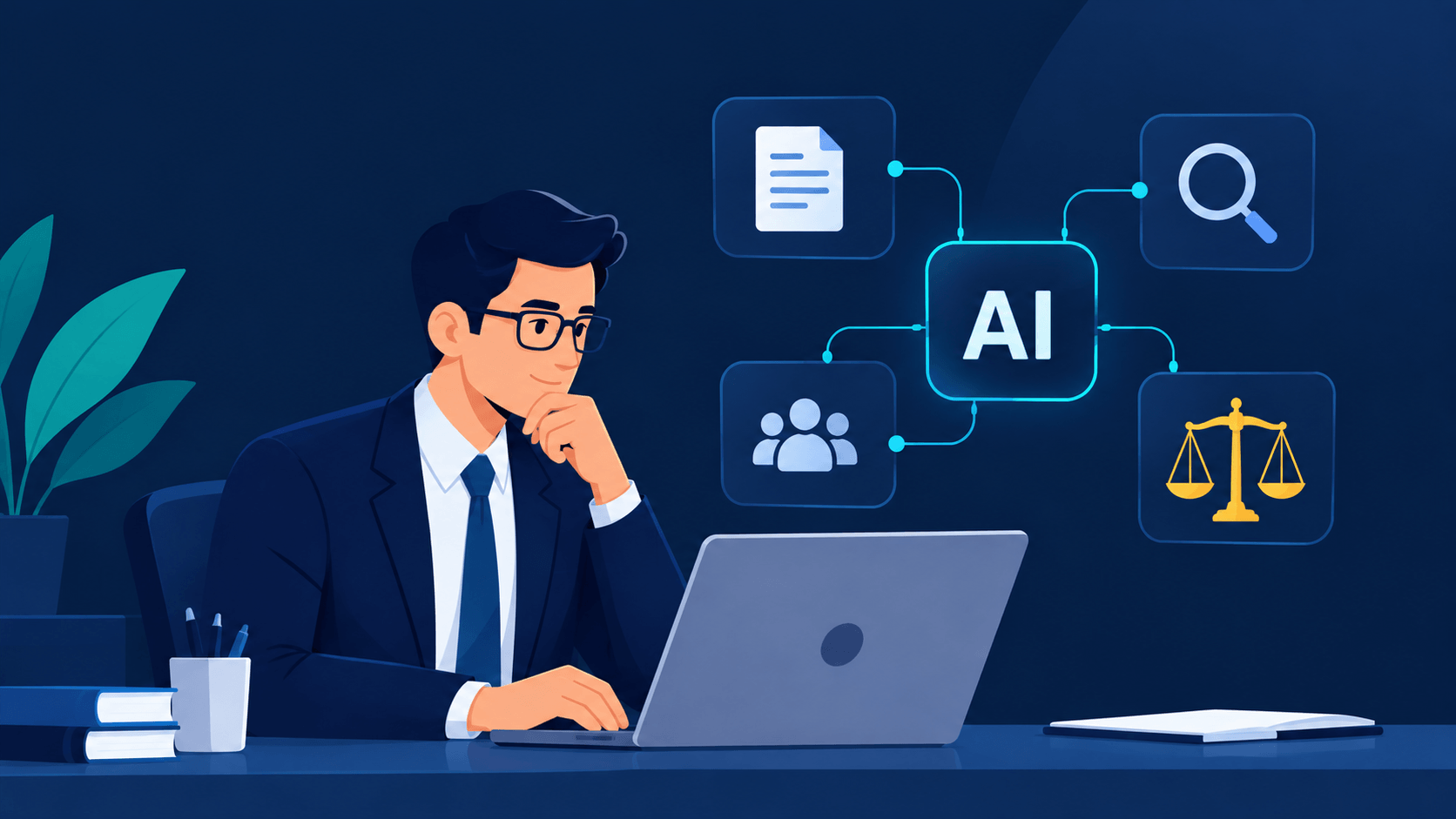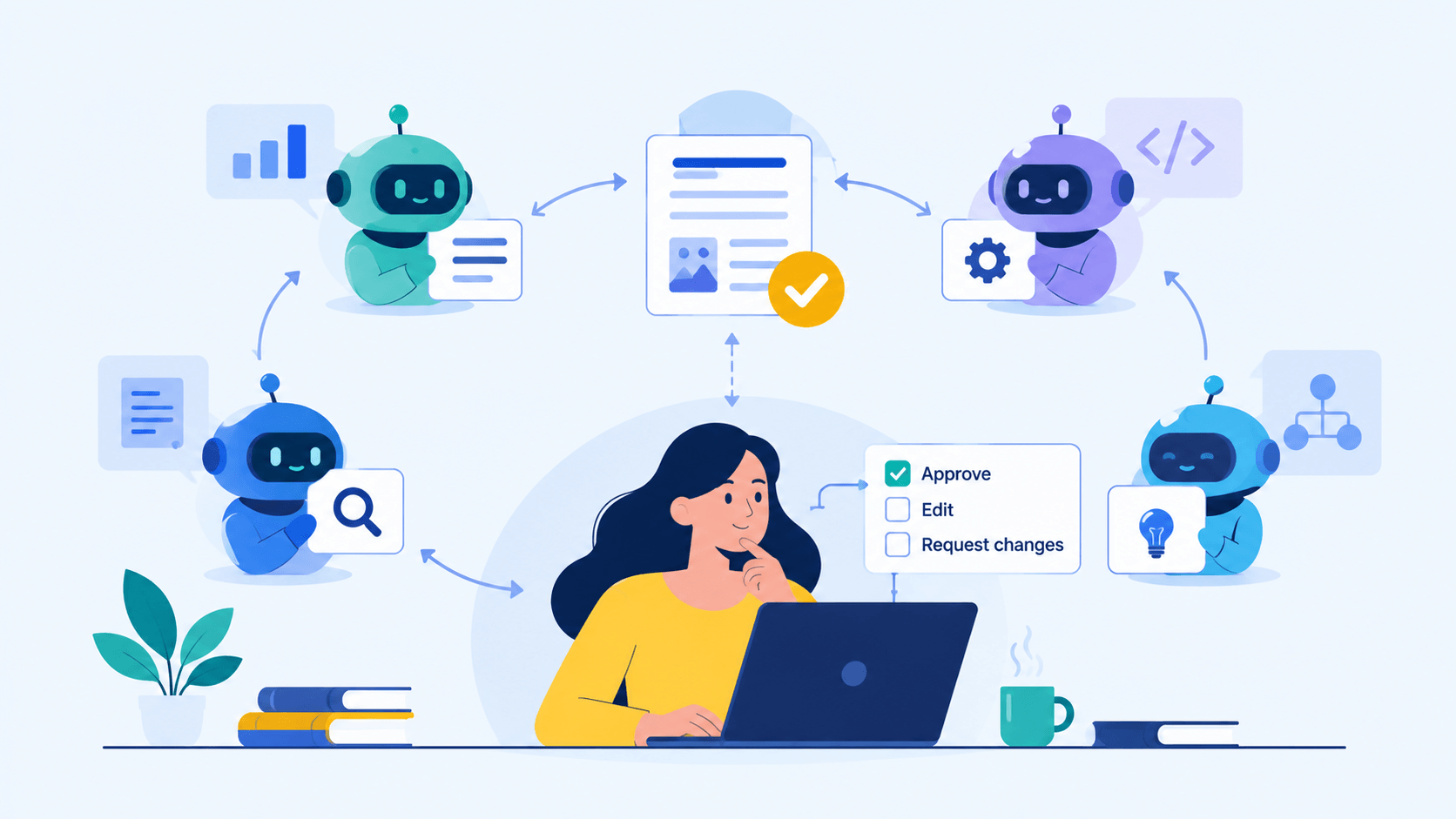

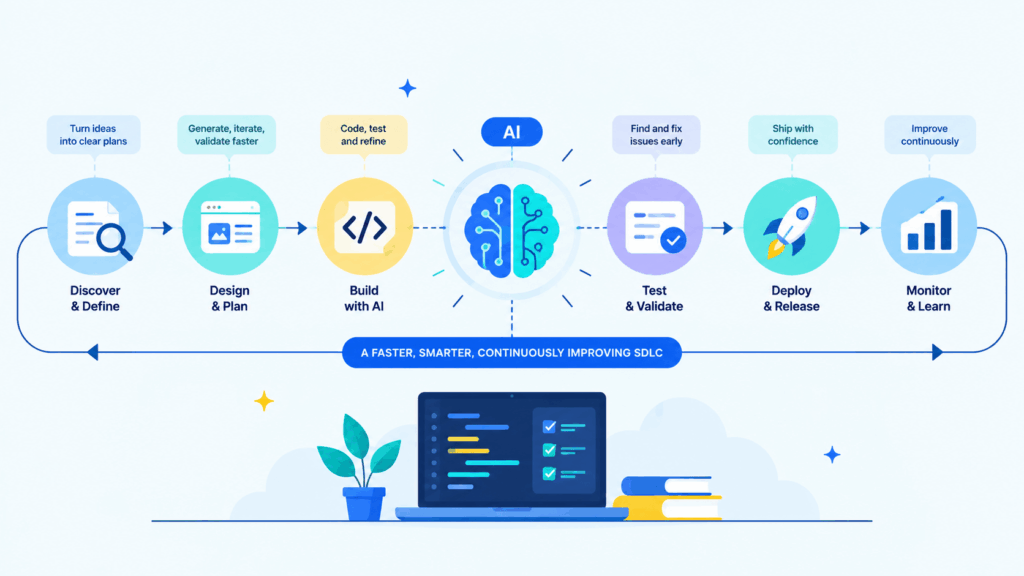
An AI-native software development lifecycle uses AI agents across specification, architecture, implementation, review and release, with senior engineers approving each phase. The change is not uniform acceleration. Implementation compresses sharply while specification and review become the new constraints, which is why most teams see modest gains.
Table of contents
- Two different things called the AI SDLC
- What most guidance gets wrong
- Where the bottleneck moves
- The lifecycle, phase by phase
- What gets harder, not easier
- What this means for how you staff a team
- How to measure whether it worked
- Where this goes wrong
- How Wow Labz runs an AI-native lifecycle
- Frequently asked questions
Almost everything written on this subject describes AI making existing phases faster: AI writes the code, AI writes the tests, AI reviews the pull request. All true, and it misses the structural point. When implementation becomes cheap, the constraint moves somewhere else, and where it lands determines whether you get a 20% improvement or a genuine change in how fast you can ship.
About Wow Labz. Wow Labz is an AI-native custom software development company based in Bengaluru, India. Since 2011 it has shipped 400+ products across 15+ years, won 30+ awards, and touched 100M+ lives, for clients including Coca-Cola, AB InBev, HDFC, Emaar and UCSF. It holds a 5.0 rating across 23 verified Clutch reviews and is ISO 27001 certified.
Two different things called the AI SDLC
Worth separating these at the outset, because search results mix them and they are unrelated problems.
| Term | What it means | Who cares |
|---|---|---|
| AI in the SDLC | Using AI agents and tools inside your software delivery process to build any kind of software | Engineering leaders trying to ship faster |
| AI development lifecycle | The lifecycle for building AI systems specifically: data, training, evaluation, monitoring, governance | Teams shipping ML or generative AI products |
This article is about the first. The second is a real and separate discipline, and if that is what you came for, the parts worth reading here are the sections on review and evaluation, because the practices overlap there.
What most guidance gets wrong
The common framing is that AI accelerates each phase of the lifecycle. Faster coding, faster tests, faster documentation. The arithmetic of that framing does not support the claims made on top of it.
Suppose implementation was around 45% of total effort on a project, which is roughly typical, and AI halves it. The project gets about 22% faster. That is a real and worthwhile gain, and it is nothing like the tenfold improvements the category talks about. Meanwhile the volume of code arriving for review has gone up, so review effort rises rather than falls, eating into even that 22%.
The interesting question is not how much faster each phase gets. It is which phase becomes the constraint once implementation is no longer it.
Where the bottleneck moves
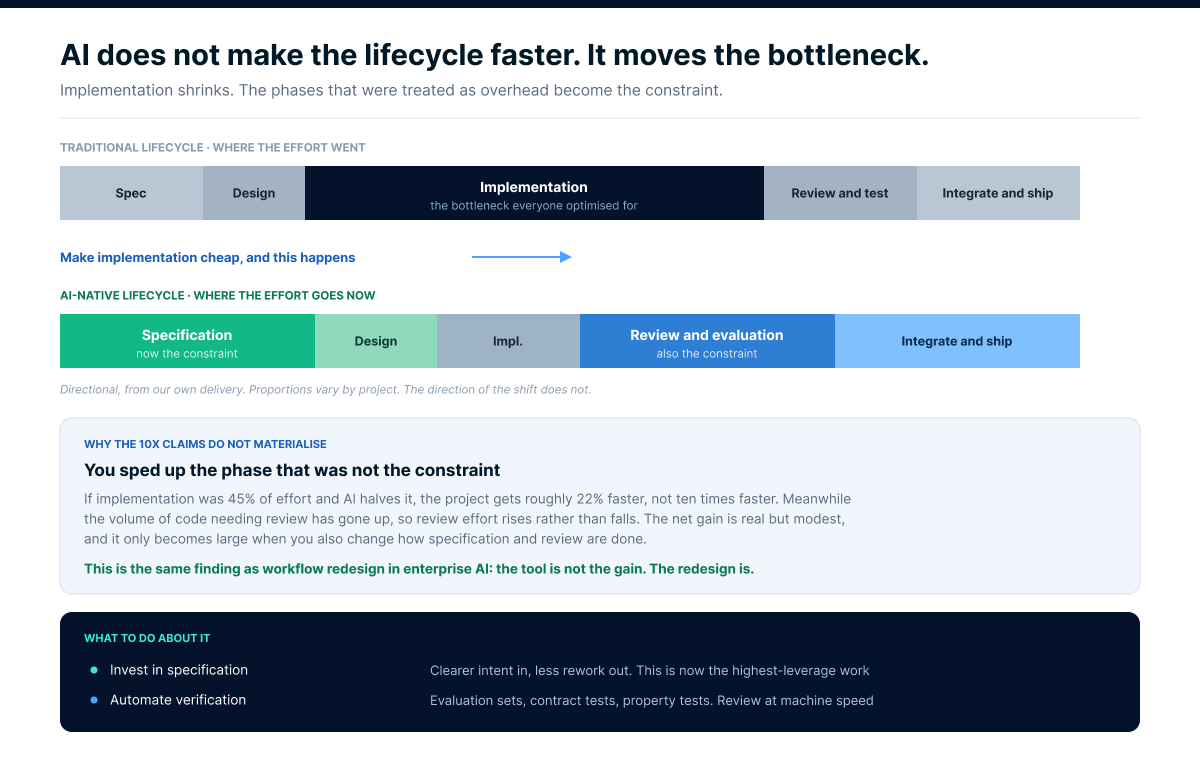
It moves to two places, and they are the two phases most organisations treat as overhead.
Specification becomes the constraint
When implementation is cheap, the cost of building the wrong thing goes up in relative terms, because you can now build the wrong thing considerably faster. Ambiguity in a brief that used to be absorbed and resolved during weeks of implementation now propagates straight into working software.
This is the highest-leverage work in an AI-native lifecycle and it is the least automatable. An agent can draft user stories, surface edge cases and find contradictions in a brief. It cannot decide what is worth building or what success looks like.
Review becomes the constraint
More code, produced faster, all of it needing verification. Human line-by-line review does not scale to that volume, and teams that try either become the bottleneck themselves or quietly stop reviewing properly, which is worse because it is invisible.
The resolution is to automate verification rather than only generation: evaluation sets, contract tests, property-based tests, and machine first-pass review, with humans focused on whether the thing solves the actual problem, which tests cannot tell you.
This mirrors the finding from enterprise AI more broadly. McKinsey’s state of AI research identifies redesigning workflows as the practice separating organisations that see financial impact from those that do not. Adopting AI coding tools without changing how specification and review work is the software delivery version of layering AI onto an unchanged process.
The lifecycle, phase by phase
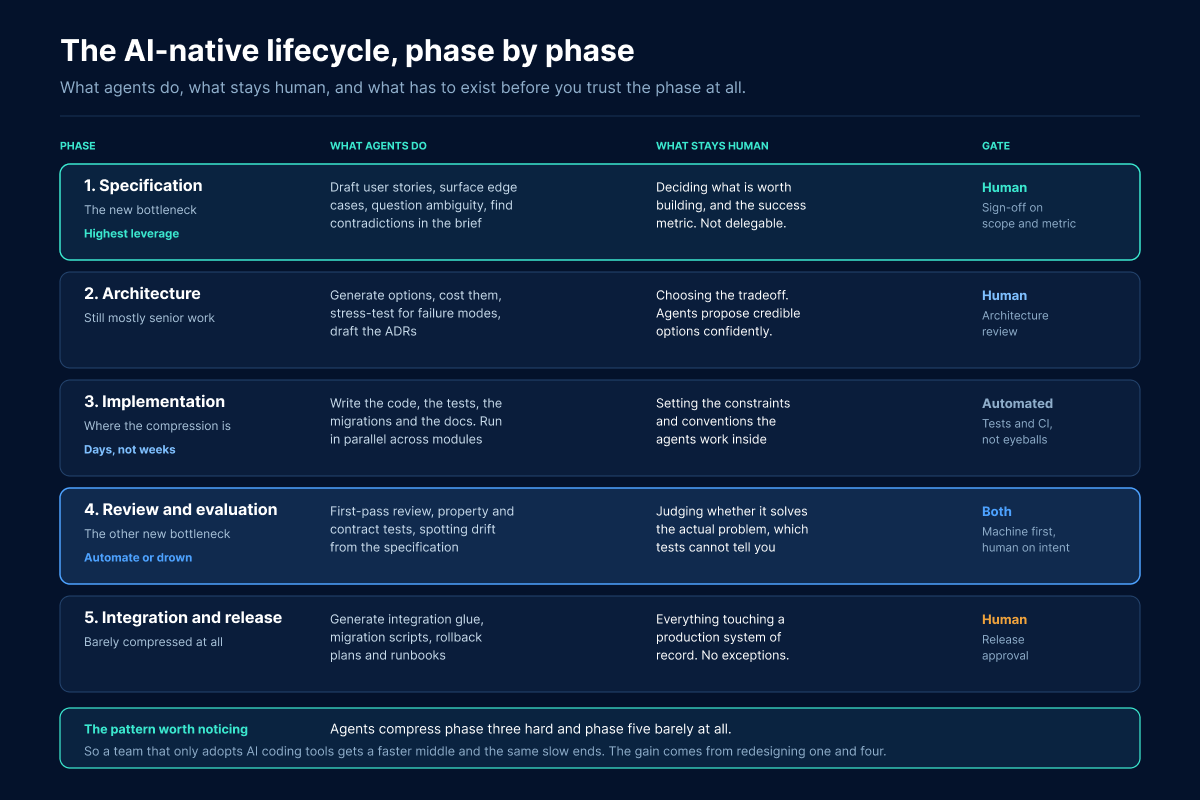
- Specification. Agents draft user stories, surface edge cases, question ambiguity and find contradictions in the brief. Humans decide what is worth building and what the success metric is. Gate: human sign-off on scope and metric. This is where the leverage is.
- Architecture. Agents generate options, cost them, stress-test for failure modes and draft the decision records. Humans choose the tradeoff, because agents propose credible options confidently and cannot weigh what your organisation can actually live with. Gate: architecture review.
- Implementation. Agents write code, tests, migrations and documentation, running in parallel across modules. Humans set the constraints and conventions the agents work inside. Gate: automated tests and CI rather than eyeballs. This is where the compression is real.
- Review and evaluation. Agents do first-pass review, property and contract tests, and spot drift from the specification. Humans judge whether it solves the actual problem. Gate: machine first, human on intent. Automate this or drown.
- Integration and release. Agents generate integration glue, migration scripts, rollback plans and runbooks. Humans approve anything touching a production system of record, without exception. Gate: human release approval.
The pattern worth noticing. Agents compress phase three hard and phase five barely at all. A team that adopts AI coding tools and changes nothing else gets a faster middle and the same slow ends, which is precisely why the measured gains disappoint. The improvement comes from redesigning phases one and four.
What gets harder, not easier
Being honest about the costs matters, because they are real and they are where teams get caught out.
- Review load. More code arriving faster means more to verify. If review capacity does not change, the queue grows until someone starts approving without reading.
- Architectural drift. Agents generate plausible code that matches local patterns without necessarily matching your intent. Drift is subtle and accumulates across a codebase faster than a human team would produce it.
- Comprehension debt. Code generated quickly can be understood slowly. If nobody on the team can explain a module, you have a maintenance liability regardless of whether it works today.
- Specification ambiguity. Ambiguity in a brief used to surface during implementation, when a developer asked a question. That feedback loop is weaker now, so ambiguity reaches production instead.
- Ongoing cost. Inference costs, evaluation infrastructure and monitoring are recurring line items that a traditional build did not carry.
What this means for how you staff a team
The shape of a team changes more than its size.
| Role | How the work changes |
|---|---|
| Senior engineers | More valuable, not less. Their judgement on architecture and intent is the scarce input, and they spend less time on implementation |
| Junior engineers | The traditional route in, writing simple code under supervision, is the part that compressed most. Growth now comes through review and specification work, which needs deliberate design |
| Product and business analysts | Substantially more leverage. Specification quality is now a direct determinant of delivery speed |
| QA and test engineering | Shifts from writing test cases to designing evaluation strategy and automated verification |
| Technical writers | Agents draft documentation well. The remaining work is deciding what needs documenting and verifying it is true |
The junior engineer question is the one worth sitting with. If the tasks people used to learn on are now done by agents, teams have to create learning paths deliberately rather than relying on them emerging from the work.
How to measure whether it worked
- Cycle time from specification to production. Not lines of code or number of pull requests, both of which go up whether or not anything improved.
- Change failure rate. If this rises while cycle time falls, you have bought speed with quality and the trade will reverse within a quarter.
- Time spent in review as a share of total. The clearest signal of whether review is genuinely happening or has quietly become a formality.
- Rework rate. Rework caused by unclear requirements is the metric that tells you whether specification investment is paying off.
- Comprehension check. Ask engineers whether they can explain the modules they own. A declining answer is comprehension debt accumulating.
Take a baseline before changing anything. The most common failure in this whole area is a team that adopts AI tooling, feels faster, and has no evidence either way six months later.
Where this goes wrong
- Treating it as a tooling upgrade. Tools adopted, process unchanged, gains modest, everyone disappointed. The most common outcome by a wide margin.
- No constraints on the agents. Agents given broad latitude with no constraints produce a codebase nobody chose. Conventions and boundaries have to be explicit.
- Skipping the review redesign. Review becomes a formality within weeks, and the first anyone knows is an incident in production.
- Ignoring the ends. Speed at the middle of the lifecycle with unchanged release governance produces a queue rather than faster delivery.
- Letting comprehension debt run. A team that shipped faster for a quarter and cannot explain half its codebase has borrowed against next year.
How Wow Labz runs an AI-native lifecycle
Our agentic delivery platform, NeoCrew, is how we ship production software in days rather than the weeks a traditional agency quotes. The part worth explaining is what we do with the time that frees up, because that is where the actual advantage sits.
It goes into specification and review. Discovery is a real phase with a named output rather than a kickoff call, because ambiguity now reaches production faster than it used to. Review is automated first and human on intent, so verification scales with generation. And every phase has a gate with a senior engineer on it, which is the difference between compressed delivery and unsupervised delivery.
Two things this connects to. The oversight design is covered in detail in our guide to human-in-the-loop AI, and the build-or-buy question that precedes any of this sits in our custom software development guide. If you want to see the lifecycle applied to a single decision rather than a whole project, the AI proof of concept guide describes a two-week version of it.
We have shipped more than four hundred products since 2011, which mostly means we ran the traditional lifecycle long enough to know which parts of it were load-bearing. The ones we kept are the gates.
Wondering what AI-native delivery would actually change for your team?
The honest answer depends on where your current bottleneck is, and most teams have not measured it. In a Discovery Sprint we look at your delivery process, identify which phase is actually the constraint, and tell you what would change and what would not. Talk to us about your delivery process and we will tell you if tooling alone would be enough.
Frequently asked questions
What is an AI-native software development lifecycle?
It is a delivery process where AI agents work across specification, architecture, implementation, review and release, with senior engineers approving each phase. It differs from simply adopting AI coding tools, because the phases themselves are redesigned rather than just accelerated.
How much faster is AI-native development?
Less than the headline claims suggest if you only change tooling. If implementation was around 45% of effort and AI halves it, the project gets roughly 22% faster, and rising review load erodes some of that. Larger gains require redesigning specification and review, which is where the constraint moves.
What is the difference between AI in the SDLC and the AI development lifecycle?
AI in the SDLC means using AI inside your delivery process to build any kind of software. The AI development lifecycle refers to building AI systems specifically, covering data, training, evaluation, monitoring and governance. They are separate disciplines that search results frequently conflate.
Does AI replace software engineers?
It replaces a portion of implementation work, which changes what engineers spend their time on rather than removing the need for them. Senior judgement on architecture and intent becomes the scarce input. The harder question is junior progression, since the tasks people traditionally learned on are the ones that compressed most.
Which SDLC phases does AI actually compress?
Implementation compresses sharply. Specification and architecture compress somewhat, because agents can draft and stress-test options but cannot make the decisions. Integration and release barely compress at all, because they touch production systems and require human approval. A faster middle with unchanged ends produces a queue, not faster delivery.
What gets harder in an AI-native lifecycle?
Review load, because more code arrives faster. Architectural drift, because agents produce plausible code that may not match intent. Comprehension debt, because code generated quickly can be understood slowly. And specification ambiguity, which used to surface when a developer asked a question and now reaches production instead.