Custom AI solutions are AI systems built around a specific workflow rather than configured from a generic off-the-shelf tool. Build custom when the workflow is a genuine differentiator or your data and compliance needs are unusual. Buy when a category tool already covers most of it. Most production systems end up hybrid.
Almost every vendor in this market has an incentive to tell you that custom is the answer, and almost every SaaS vendor has an incentive to tell you it is not. Both are sometimes right. This guide gives you the decision framework instead of the sales pitch, including the cases where we tell prospective clients not to build.
About Wow Labz: Wow Labz is an AI-native custom software development company based in Bengaluru, India. Since 2011 it has shipped 400+ products across 15+ years, won 30+ awards, and touched 100M+ lives, for clients including Coca-Cola, AB InBev, HDFC, Emaar and UCSF. It holds a 5.0 rating across 23 verified Clutch reviews and is ISO 27001 certified.
What counts as a custom AI solution
A custom AI solution is one designed around how your organisation actually works, rather than one you adapt your workflow to fit. The term covers a wide range, which is part of why the build-or-buy conversation gets muddled.
At the light end, custom can mean a foundation model grounded in your own documents through retrieval. In the middle, it can mean a fine-tuned model that has learned your formats and conventions. At the heavy end, it means an orchestrated system of AI agents running a workflow that exists nowhere else. These are radically different commitments, and treating them as one decision is the first mistake.
The four routes, and what each really costs
The sticker price is rarely the real cost. What matters is where the ongoing burden lands once the system is live.
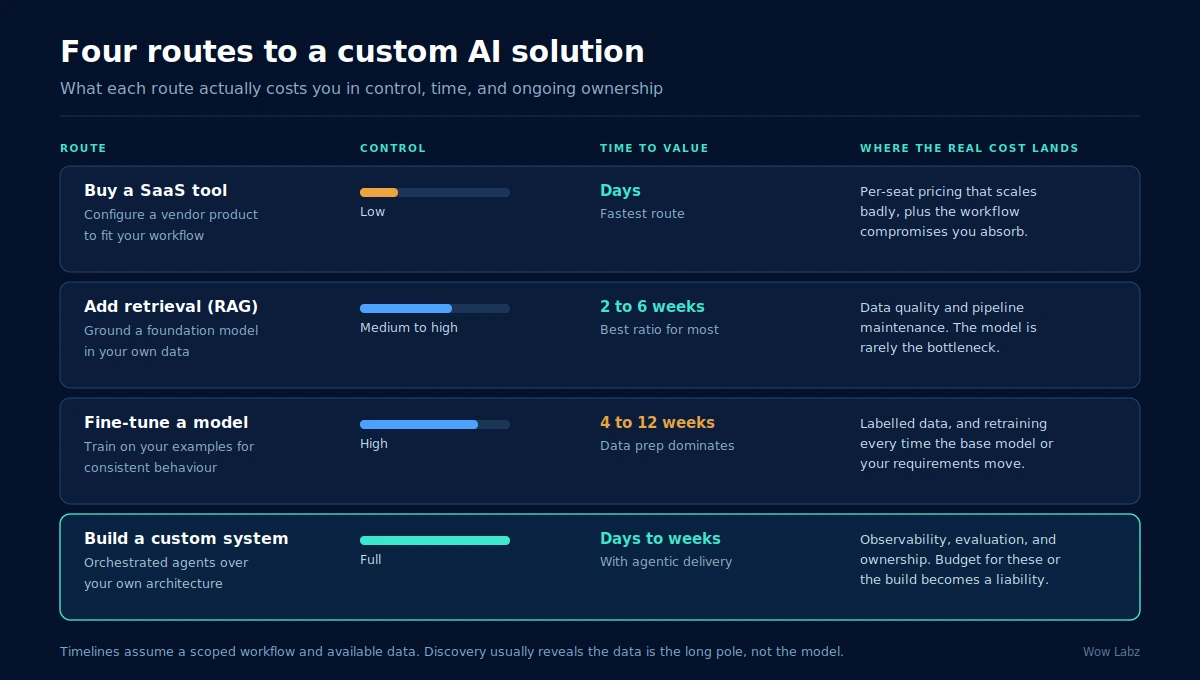
| Route | Control | Typical time | Where the real cost lands |
|---|---|---|---|
| Buy a SaaS tool | Low | Days | Per-seat pricing at scale, plus workflow compromises |
| Add retrieval (RAG) | Medium to high | 2 to 6 weeks | Data quality and pipeline maintenance |
| Fine-tune a model | High | 4 to 12 weeks | Labelled data, and retraining as models move |
| Build a custom system | Full | Days to weeks with agentic delivery | Observability, evaluation, and long-term ownership |
Two things in that table surprise people. Retrieval usually delivers the best ratio of control to effort, and it is where we start most engagements. And the cost of a full custom build is dominated not by writing it but by keeping it reliable afterwards.
A decision tree for build, buy, or fine-tune
Four questions, asked in this order, resolve most of these decisions without a lengthy evaluation cycle.
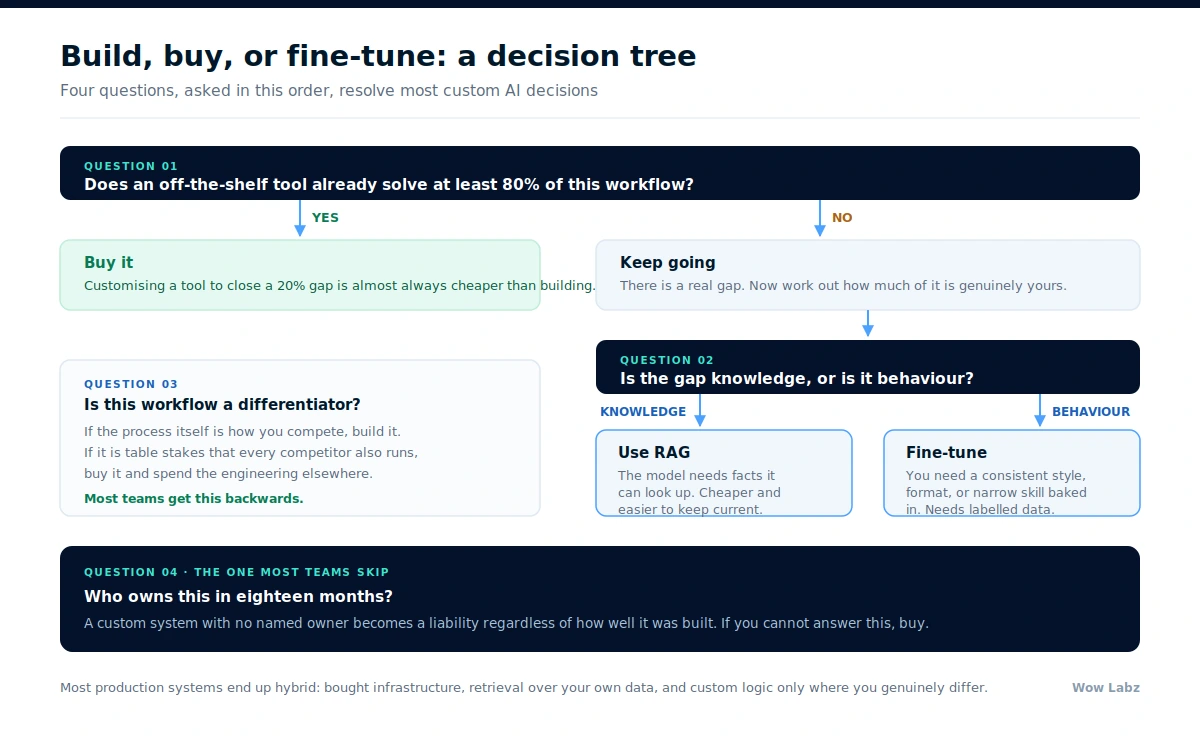
- Does an off-the-shelf tool already solve at least 80% of this workflow? If yes, buy it and customise the remainder. Closing a 20% gap on a bought tool is almost always cheaper than building the whole thing, and the maintenance burden stays with the vendor.
- Is the gap knowledge, or is it behaviour? A knowledge gap means the model needs facts it can look up, which points to retrieval. A behaviour gap means you need a consistent style, format, or narrow skill, which points to fine-tuning. Confusing the two leads teams to fine-tune when retrieval would have been cheaper and easier to keep current.
- Is this workflow a differentiator? If the process itself is how you compete, build it. If it is table stakes every competitor also runs, buy it and spend your engineering effort where you actually differ. Most teams get this backwards, building the commodity and buying the differentiator.
- Who owns this in eighteen months? This is the one most teams skip, and it decides more outcomes than the technical questions. Covered in its own section below.
When custom is the right answer
- Proprietary data. Your data is the advantage. If you hold proprietary data that no vendor can replicate, a system built to exploit it compounds in value while a bought tool does not.
- Unusual compliance surface. Regulated industries frequently need auditability, data residency, or explainability that SaaS tools cannot provide at any price. This is a common driver in fintech and healthcare work.
- The workflow is the product. If the workflow itself is how you win, handing it to a vendor means capping your advantage at whatever they offer everyone else.
- Scale economics. Per-seat pricing that looks reasonable for fifty users often becomes indefensible at five thousand. At sufficient scale, custom is simply cheaper.
- Integration depth. When the workflow spans several systems of record and needs judgement at multiple steps, no single tool covers it, and stitching four tools together is its own custom build with none of the control.
When custom is the wrong answer
We turn down custom builds fairly regularly, and it is worth being direct about when.
- A good tool already exists. If a category tool covers the workflow well and you have no unusual compliance or scale requirement, building it is an expensive way to arrive at the same place later.
- The process is still changing weekly. Custom systems assume a stable target. If the workflow is still being invented, buy something cheap, learn what you actually need, then build once the requirements stop moving.
- There is no owner. If nobody can commit to maintaining it, the build will degrade into a liability regardless of how well it was engineered.
- The data is not ready. Almost every AI project turns out to be a data project. If the data is scattered, unlabelled, or of unknown quality, fix that first. A custom model on poor data is an expensive way to automate errors.
- The success metric is undefined. If the honest answer to “what does success look like” is “we will know it when we see it”, the project is not ready for a build decision yet.
The question most teams skip
Who owns this in eighteen months? Not who builds it, and not who signs off on it. Who is accountable for keeping it working when the base model changes underneath it, when a data source shifts format, and when the person who understood the architecture has moved on?
A custom AI system with no named owner becomes a liability regardless of how well it was built. This is a large part of why so many pilots quietly die: not because they failed, but because nobody was responsible for their success after launch. If you cannot answer this question, buy something instead, or budget for a partner who carries the ownership with you.
The industry data bears this out. Gartner projects that over 40% of agentic AI projects will be canceled by the end of 2027, citing escalating costs, unclear business value, and inadequate risk controls, and MIT’s NANDA report found that 95% of enterprise generative AI pilots deliver no measurable business impact, attributing the gap to weak integration rather than weak models. Ownership and integration are governance problems, not AI problems.
How to scope a custom AI project
If you have worked through the decision tree and custom is the answer, scope it in this order. Each step is deliberately cheap to reverse.
- Pick the narrowest valuable slice. One workflow, one measurable outcome. Not a platform, not a strategy. Breadth is what kills these projects.
- Audit the data before designing anything. Find out what exists, where, in what condition, and who controls access. This is where most timelines actually get set, and discovering it late is the single most common cause of overrun.
- Define the human checkpoints. Decide up front which steps a human must approve. Retrofitting oversight is far harder than designing it in, and it is the first thing auditors and customers ask about.
- Build the evaluation set early. Assemble the test cases that define success before you build, so you can tell whether you are improving.
- Timebox a proof of concept. Prove the riskiest assumption on real data in one or two weeks, and end with a build-or-stop decision plus a fixed estimate rather than an open-ended experiment.
How Wow Labz approaches custom AI
We start every engagement with the build-or-buy question rather than assuming the answer, because a client who buys the right tool and comes back for the genuinely hard problem is worth more than one who builds the wrong thing with us. When custom is right, we design for ownership from the start: observability, evaluation, and human checkpoints in the architecture rather than added afterwards.
Our agentic delivery platform, NeoCrew, is how we ship custom systems in days rather than the weeks a traditional build takes. If the workflow you are considering involves coordinating several AI agents, our guide to AI orchestration covers the architecture, and our AI development services and AI and ML consulting pages set out how we engage.
Not sure whether to build or buy?
That is the conversation we would rather have first. In a Discovery Sprint we look at your workflow, your data, and your compliance surface, and tell you plainly which route fits, including when the answer is to buy something off the shelf instead. You leave with a recommendation and a fixed estimate. Talk to us about your AI project and we will give you an honest read before anyone talks about scope.
Frequently asked questions
What are custom AI solutions?
Custom AI solutions are AI systems built around a specific organisational workflow rather than configured from a generic off-the-shelf product. They range from a foundation model grounded in your own data through retrieval, to a fine-tuned model, to a fully orchestrated system of AI agents.
Is it cheaper to build or buy an AI solution?
Buying is almost always cheaper up front. Building becomes cheaper at scale, particularly where per-seat pricing grows faster than your usage, or where a bought tool forces workflow compromises that cost you elsewhere. The deciding factor is usually ongoing ownership cost rather than the initial build.
When should I fine-tune instead of using RAG?
Fine-tune when you need consistent style, format, or a narrow behaviour baked into the model, and you have labelled examples to train on. Use retrieval when the model needs access to facts that change or that it never saw in training. Retrieval is generally cheaper, faster to iterate, and easier to keep current.
How long does a custom AI solution take to build?
Retrieval-based systems typically take two to six weeks. Fine-tuning takes four to twelve, with data preparation dominating. A full custom system varies widely, and with agentic delivery methods the build can compress to days, though data access and quality usually set the real timeline.
What is the biggest risk with custom AI?
Ownership. A custom system with nobody accountable for maintaining it degrades regardless of build quality, because base models change, data sources shift, and institutional knowledge leaves. Decide who owns it in eighteen months before you commit to building.
Do I need custom AI, or is my problem actually a data problem?
Frequently the latter. If your data is scattered, unlabelled, or of unknown quality, no model will fix that, and a custom system built on it will automate the errors faster. Audit the data first. It is cheaper than discovering the issue mid-build.