
AI orchestration is the coordination layer that directs multiple AI models and agents to complete a multi-step task as one system. It manages sequencing, shared memory, tool calls, error recovery, and human checkpoints. In short, it turns isolated model calls into reliable production workflows instead of one-off prompts.
That distinction is the whole game right now. A single AI agent answering a question is a tool. Five agents that research, decide, draft, review, and act on live business systems are a different kind of software, and they only stay useful if something coordinates them. AI orchestration is that something, and it is the layer most teams discover they are missing only after their pilot stalls.
About Wow Labz: Wow Labz is an AI-native custom software development company based in Bengaluru, India. Since 2011 it has shipped 400+ products across 15+ years, won 30+ awards, and touched 100M+ lives, for clients including Coca-Cola, AB InBev, HDFC, Emaar and UCSF. It holds a 5.0 rating across 23 verified Clutch reviews and is ISO 27001 certified.
Why AI orchestration matters in 2026
The appetite for multi-agent systems is real, and so is the failure rate. Gartner projects that over 40% of agentic AI projects will be canceled by the end of 2027, citing escalating costs, unclear business value, and inadequate risk controls. Separately, MIT’s NANDA report, The GenAI Divide: State of AI in Business 2025, found that 95% of enterprise generative AI pilots deliver no measurable business impact, with the authors attributing the gap to weak integration rather than weak models.
Read those two findings together and a pattern emerges. The models are good enough. What fails is the architecture around them: no shared state between agents, no error handling when a step times out, no audit trail when a decision needs explaining, and no human oversight at the points that carry real consequences.
Orchestration is where those gaps close. Get it right and a set of narrow, unremarkable agents becomes a dependable system. Get it wrong and the same coordination that creates leverage also stacks errors, hides what went wrong, and produces inference bills nobody can reconstruct after the fact.
How AI orchestration works: the six-stage loop
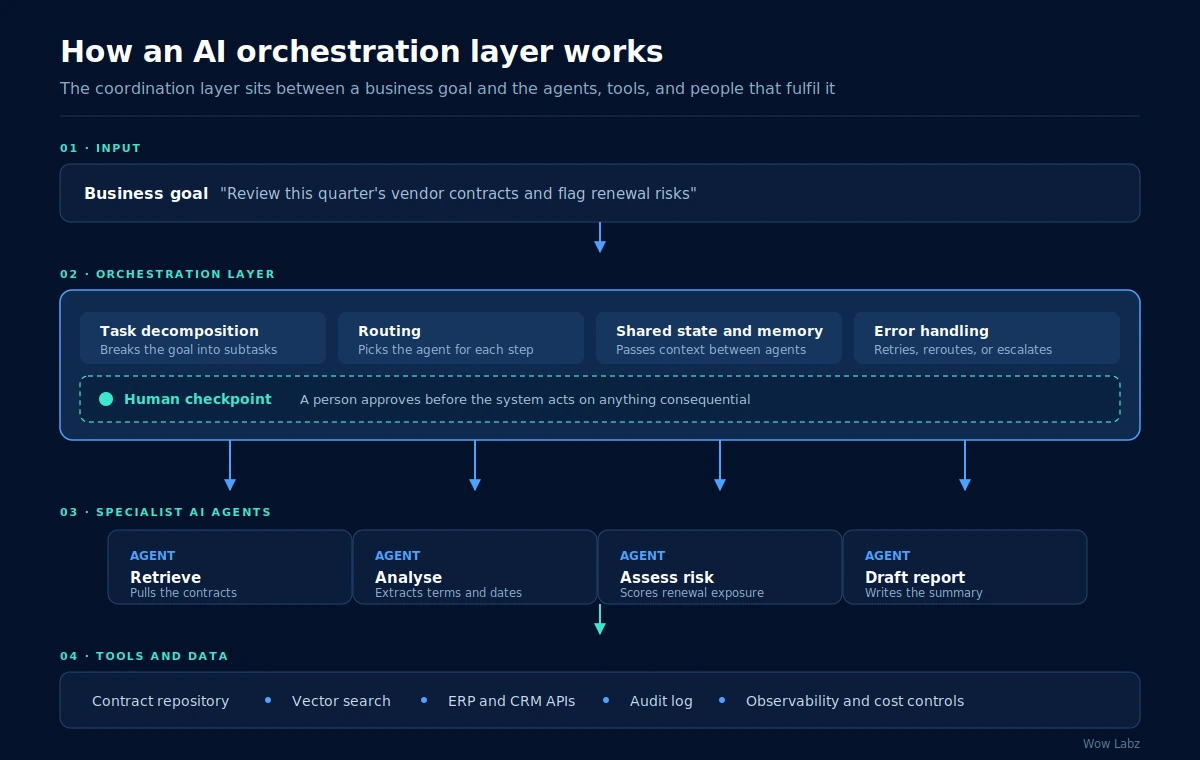
Underneath the terminology, an orchestration layer runs a loop until the goal is met or a stop condition fires. Six things happen inside it.
- Task decomposition. The system breaks a complex goal into smaller, well-scoped subtasks. This is where most reliability is won or lost, because a badly decomposed task produces agents working at cross purposes.
- Routing. It decides which agent or model handles each subtask, and in what order. Routing can be static, defined in advance, or dynamic, decided at runtime based on the input.
- Shared state and memory. It passes context between agents so each one knows what the others produced. Without this, agents repeat work, contradict each other, or lose the thread entirely.
- Tool and data calls. Agents reach databases, APIs, and external systems through standard interfaces. The Model Context Protocol has become the common way to expose tools to agents without writing bespoke glue for each one.
- Error handling. When an agent fails or times out, the layer retries, reroutes, or escalates rather than letting the whole run collapse. This is the single most skipped stage in prototypes and the most necessary one in production.
- Human checkpoints. At defined gates, a person reviews or approves before the system continues. This is the difference between a demo and something you can put in front of a customer.
The five AI orchestration patterns, compared
There is no single correct design. The pattern you choose shapes how traceable, testable, and auditable the system is once it is live, so it is worth picking deliberately rather than inheriting whatever your framework defaults to.
| Pattern | How it works | Strength | Best suited to |
|---|---|---|---|
| Manager | One lead agent calls specialist agents as tools | Easy to trace a failed run to one place | Complex tasks needing a clear owner |
| Sequential handoff | Agents pass work down a defined chain | Simple to reason about and test | Linear processes with clear stages |
| Graph-based | Nodes and edges define a deterministic flow | Replayable and auditable | Regulated or production-critical systems |
| Role-based crew | Agents hold fixed roles and collaborate | Maps onto existing job functions | Business workflows mirroring a real team |
| Conversational loop | Agents talk freely until the task resolves | Flexible on open-ended problems | Research and exploration, not production |
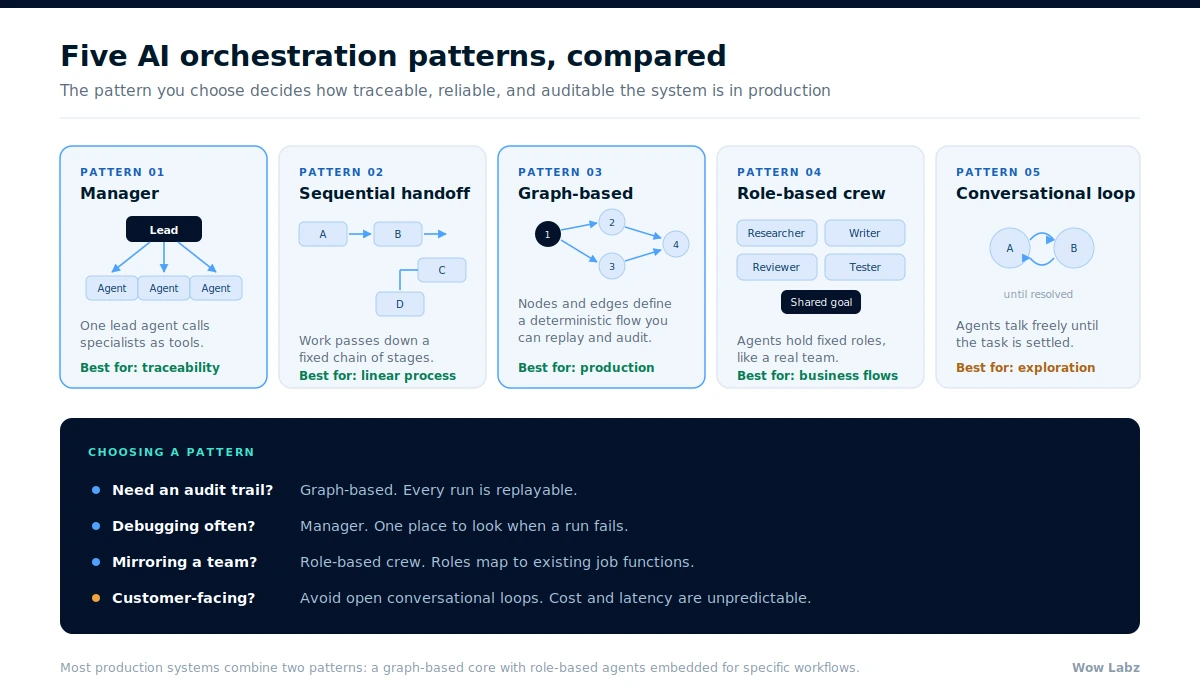
For most production use cases the manager and graph-based patterns win, because control flow stays easy to follow the moment something breaks in front of a real user. Open conversational loops are the opposite: excellent for exploration, unpredictable on cost and latency, and difficult to defend in an audit.
In practice, mature systems rarely use one pattern in isolation. A common production shape is a graph-based core for the parts that must be deterministic, with role-based agents embedded inside specific nodes where judgement is needed.
AI orchestration vs automation vs a single AI agent
These three get used interchangeably and they are not the same thing. The distinction matters because it determines what you actually need to build.
| Traditional automation | Single AI agent | AI orchestration | |
|---|---|---|---|
| Reasoning | None, fixed rules | Yes, one loop | Yes, across many agents |
| Handles ambiguity | No | Somewhat | Yes, with routing and fallbacks |
| Shared memory | Not applicable | Session only | Across agents and steps |
| Error recovery | Fails or halts | Limited retry | Retry, reroute, escalate |
| Audit trail | Log of actions | Partial | Full decision trail |
| Best for | Repetitive rule-based tasks | One narrow task | Multi-step business workflows |
The practical test is simple. If your workflow has more than one step, touches more than one system of record, or needs any human oversight before it acts, you are in orchestration territory whether you planned to be or not.
The AI orchestration frameworks teams use in 2026
Four frameworks lead the category, each with a different orchestration style. LangGraph is graph-based and deterministic, which suits systems that need replayable runs. Microsoft Agent Framework converges the earlier AutoGen and Semantic Kernel projects into a single SDK and fits Microsoft-aligned stacks. CrewAI takes a role-based approach aimed at business workflows. The OpenAI Agents SDK suits rapid prototyping where OpenAI models are already the standard.
Choosing among them is the easy part, and it is where most evaluations stop. The harder work sits in the layer above: access control, cost ceilings, observability, evaluation, and compliance evidence. No framework hands you those for free, and every enterprise deployment eventually has to build or buy them.
What breaks in production, and how to prevent it
Having built orchestrated systems for enterprise clients, the failure modes we see are consistent and largely preventable. They rarely involve the model at all.
- State gets lost. Agents lose the thread across steps and either duplicate work or contradict each other. Fix it by making state explicit and versioned rather than implicit in a prompt chain.
- No failure path. A prototype assumes every call succeeds. Production does not. Fix it by defining, for every agent, what happens on timeout, on malformed output, and on tool failure.
- No audit trail. When a decision is questioned weeks later, nobody can reconstruct why the system acted. Fix it by logging inputs, outputs, and the routing decision at every step from day one, not after the first incident.
- Runaway cost. A loop that retries indefinitely turns into an unbounded bill. Fix it with hard token and step ceilings per run, enforced at the orchestration layer rather than trusted to the agent.
- Oversight in the wrong places. Autonomy gets applied uniformly instead of proportionally to risk. Fix it by mapping consequence to oversight: low-stakes steps run unattended, consequential ones pause for approval.
Notice that four of those five are engineering discipline rather than AI expertise. That is precisely why so many capable teams stall between a working demo and a system the business will actually rely on.
Build or buy: choosing your orchestration approach
Three routes are viable, and the right one depends on how much of your workflow is genuinely distinctive.
- Buy a platform. Fastest to a result, least control. Sensible when your workflow is close to a common pattern the vendor already supports and you have no unusual compliance surface.
- Build on an open framework. Full control, and the real cost lands in observability, state management, and evaluation rather than in the initial build. Choose it when the orchestration logic is itself a differentiator.
- Hybrid. The common enterprise answer in 2026. A bought control plane for governance, with custom orchestration where the business logic is specific to you.
Whichever route you take, decide the human checkpoints before you decide the framework. Oversight design is far harder to retrofit than a technology swap, and it is the thing auditors and customers ask about first.
How Wow Labz builds orchestrated AI systems
Wow Labz builds orchestrated multi-agent systems the way they have to run in the real world: human oversight at every checkpoint, observability from the first commit, and a production architecture instead of a proof of concept that quietly dies. Our agentic delivery platform, NeoCrew, is how we ship these systems in days rather than the weeks a traditional build takes, without trading away control or accountability.
If you are weighing frameworks or patterns right now, the useful next step is usually not more evaluation. It is mapping your actual workflow, the agents it needs, and where a human has to sign off. That is what our AI agent development team does in a Discovery Sprint, and it is also worth reading our guide to evaluating AI agent frameworks if you are at the shortlisting stage.
Planning an orchestrated multi-agent system?
Most orchestration projects fail on scoping, not technology. In a Discovery Sprint we map your workflow end to end, identify which steps need an agent and which need a human, and hand you a production architecture with a fixed estimate, before you commit to a build. Talk to our team about your orchestration project and we will tell you honestly whether agents are the right answer for it.
Frequently asked questions
What is orchestration in AI?
Orchestration in AI is the coordination layer that gets multiple AI models or agents to work together on one task. It manages the order they run in, the context they share, the tools they call, and what happens when one of them fails.
What is the difference between AI orchestration and AI automation?
Traditional automation follows fixed rules and does not reason. AI orchestration coordinates agents that reason, adapt, share state, and recover from errors across a multi-step workflow. Automation handles the task; orchestration directs the flow between tasks.
Is an AI agent an orchestrator?
It can be. In the manager pattern, one lead agent acts as the orchestrator and calls other agents as tools. In graph-based systems the orchestration logic sits outside the agents entirely, in a defined flow. Both are valid; the second is easier to audit.
What is the best AI orchestration tool?
There is no single best tool. LangGraph suits deterministic production flows, CrewAI suits role-based business workflows, Microsoft Agent Framework suits Microsoft-aligned stacks, and the OpenAI Agents SDK suits fast prototyping. Most enterprises end up combining more than one, plus a governance layer above them.
Do I need AI orchestration for a single agent?
Not usually. A single agent handling one narrow task with one reasoning loop does not need an orchestration layer. You need one as soon as the workflow spans multiple steps, multiple systems, or requires human approval before acting.
Why do so many agentic AI projects fail?
Most fail on architecture rather than model capability: missing shared state, no error handling, no audit trail, unbounded cost, and no human oversight at the consequential steps. Orchestration done properly is what closes those gaps.